Getting around Osaka:
learn one line, tap one card.
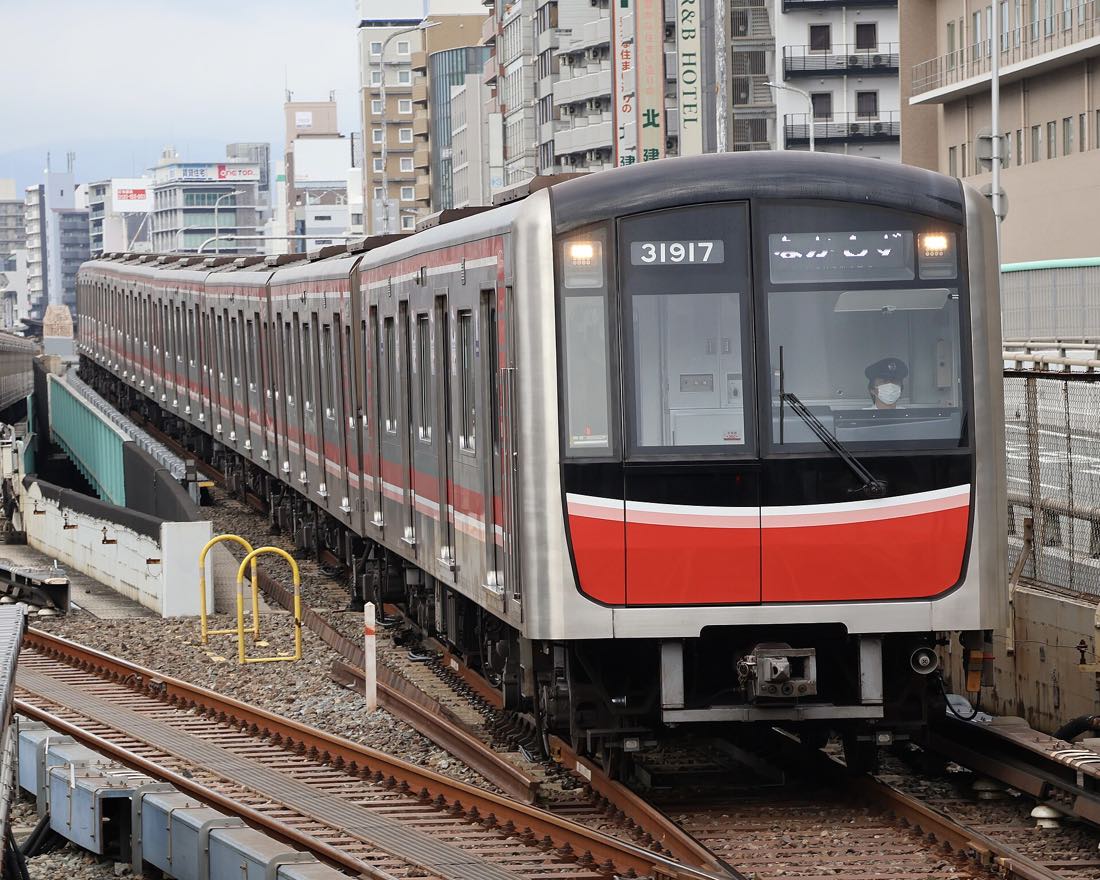
Osaka runs on three overlapping networks: the JR Loop Line, the 8-line Osaka Metro, and five private railways that each own one direction out of town. Learn the Midōsuji line first — the red spine from Shin-Osaka through Umeda, Shinsaibashi and Namba to Tennoji is 80% of a tourist week. The 2026 fact nobody tells you: Kansai is ahead of Tokyo on contactless — Osaka Metro, Nankai, Kintetsu, Hankyu and Hanshin all take foreign Visa/Mastercard/Amex/JCB tap at the gate, with automatic 1-day fare capping on the Metro. JR West and Keihan don't, and neither does anything in Kyoto — so most visitors still want an IC card. Android owners: read the FeliCa section before you plan on a phone-based card.
Three networks, one rule each
The map in wordsOsaka's stations confuse everyone because three different companies' maps are glued together. Separate them and it's simple.
1 · Osaka Metro — eight lines, your city workhorse. The Midōsuji line (red, M) is the spine: Shin-Osaka → Umeda → Honmachi → Shinsaibashi → Namba → Tennoji, one straight north–south run past almost everything. Singles ¥190–420; if you learn one line in Japan, learn this one.
2 · JR West — the Loop Line circles the city (Tokyo Yamanote logic) and radial lines run to Kyoto (¥580), Kobe (¥420) and Himeji (¥1,520). Two traps: the shinkansen stops at Shin-Osaka, not Osaka Station — they're one Metro stop apart — and JR West does not take bank-card tap at the gate.
3 · Five private railways, each owning a direction. Hankyu north to Kyoto/Kobe/Takarazuka from Umeda · Hanshin west to Kobe from Umeda · Keihan north-east to Kyoto's Gion side from Yodoyabashi/Kyōbashi · Kintetsu east to Nara from Namba · Nankai south to KIX and Kōyasan from Namba. This is why matching your hotel to a terminal matters more than any pass decision — and why each day trip has one correct railway.
Contactless tap: Kansai is ahead of Tokyo and nobody says it
The 2026 scoopYou can walk out of KIX, touch your foreign Visa, Mastercard, Amex or JCB to a Nankai gate and ride to Namba — no IC card, no ticket machine, no queue. Tap-to-ride works on: Osaka Metro (with automatic 1-day fare capping — ride five times, pay a day-pass price), Nankai, Kintetsu, Hankyu, Hanshin and the Kobe subway. That's the airport line, the Nara line, the Kobe lines and the entire city subway on the card already in your pocket.
It does NOT work on: JR West (no Loop Line, no Haruka, no Kyoto/Himeji rapids), Keihan, or anything inside Kyoto — subway and buses included. Two more catches: both your entry AND exit station must support tap, so don't board a through-service that crosses onto a non-tap operator; and each traveller needs their own physical card — no sharing one card across the family.
The honest verdict: a visitor living on Metro + Nankai + Hankyu can genuinely skip IC cards entirely in 2026. Anyone touching JR or Kyoto still needs plastic — which is most people, so read on.
IC cards in 2026 — which one, from where
The plasticAll Japanese IC cards are interoperable nationwide — an ICOCA works in Tokyo, a Suica works in Osaka. Buy whichever is in front of you and stop worrying.
| Card | Cost | Validity | Notes |
|---|---|---|---|
| ICOCA (Kansai's default) | ¥2,000 ⚠ (¥500 deposit + ~¥1,500 loaded) | 10 years | From JR West machines incl. KIX. Refundable at JR West offices only. ⚠ Sources conflict on the exact split — expect ~¥2,000 out of pocket |
| Welcome Suica Mobile | Free app, load what you like | 180 days | iPhone only. English app, foreign cards accepted, Express Transit tap without unlocking |
| Suica / PASMO in Apple Wallet | No deposit | Indefinite | iPhone 8+, any region. ICOCA can also be added. ⚠ Foreign Visa top-ups often fail — Mastercard/Amex are more reliable, konbini cash always works |
| Welcome Suica (card) | ¥1,000–10,000, no deposit | 28 days | Tokyo-airport product; fine if you land there first. No refund of leftover balance |
| Enjoy Eco Card (day pass) | ¥820 weekday / ¥620 weekend | 1 day | Osaka Metro + city bus unlimited, plus small attraction discounts. Pays for itself in 3 rides — the weekend ¥620 is the best transit deal in the city |
Prices verified August 2026. Kids' IC cards exist but must be bought at staffed counters with a passport.
Android phones cannot use Japanese IC cards
The gotchaThe single biggest practical surprise in Japan travel, stated as bluntly as it deserves: Japanese transit cards need a FeliCa (Osaifu-Keitai) chip, and most Android phones sold outside Japan don't have one enabled. No app, no workaround, no setting fixes this. The exceptions: Google Pixel 6 and later (global models carry working FeliCa) and phones originally sold in Japan.
What Android travellers actually do: buy a physical ICOCA at the airport (¥2,000, works everywhere, top up with cash at any station or konbini) and use bank-card tap on the operators that take it. That combination loses you nothing except the novelty of phone-tapping. iPhone users, meanwhile, can add Suica, PASMO or ICOCA to Apple Wallet in about a minute and never touch a ticket machine — the asymmetry is real and worth knowing before you argue with a gate.
The station-exit cheat sheet
The trust weaponOsaka's stations are mazes — Umeda is six stations wearing one name. Nobody else publishes exits; here are the ones that matter.
| You want | Station (line) | Exit | Walk |
|---|---|---|---|
| Dotonbori / Glico sign | Namba (M20/Y15/S16) | 14 or B | 5 min |
| Dotonbori from the north | Shinsaibashi (M19) | 4–6 | 5 min |
| Kuromon Ichiba | Nippombashi (S17/K17) | 10 | 2 min |
| Den Den Town | Nippombashi (S17/K17) | 5 | 3 min |
| Amerikamura | Yotsubashi (Y14) | 5 | 2 min |
| Horie / Orange Street | Yotsubashi (Y14) | 6 | 3 min |
| Shinsekai / Tsūtenkaku | Ebisuchō (K18) | 3 | 3 min |
| Shinsekai from Midōsuji | Dōbutsuen-mae (M22/K19) | 1 | 5 min |
| Osaka Castle (Ōtemon gate) | Tanimachi 4-chōme (T23/C18) | 9 | 10 min |
| Umeda Sky Building | Osaka Stn (JR) | Sakurabashi, then the underpass | 10 min |
| Grand Green Osaka | Osaka Stn (JR) | Umekita Underground | 3 min |
| Abeno Harukas | Tennoji (M23/JR) | direct | 0 min |
| Kaiyukan / Tempozan | Ōsakakō (C11) | 1 | 5 min |
| USJ | Universal City (JR Yumesaki) | direct | 3 min |
| Tenma izakaya district | JR Temma (Loop) | direct | 1 min |
| Tsuruhashi Koreatown market | Tsuruhashi (JR Loop) | West | 0 min |
| Nakazakichō cafés | Nakazakichō (T19) | 2 or 4 | 2 min |
M = Midōsuji, Y = Yotsubashi, S = Sennichimae, K = Sakaisuji, T = Tanimachi, C = Chūō. Verified August 2026.
What to actually buy
Passes, brieflyFor city days: the Enjoy Eco Card wins — ¥820 weekdays, ¥620 weekends and holidays, unlimited Metro and bus, break-even at three rides. Or just tap a bank card on the Metro and let the 1-day cap do the same job automatically. The Osaka Amazing Pass (¥3,500) is an attractions product, not a transit product — buy it for three-plus paid sights in a day, never for the trains alone.
For day trips: bare fares beat passes until you stack destinations — the whole math lives on the JR Pass page and the day-trips hub. One 2026 correction to old advice: the Kansai Thru Pass was discontinued in April 2026; its successor (Kansai Railway Pass Lite, ¥5,200/2 days) is only sold late March through September. For the airport run, the decision tree is at KIX to the city — short version: Nankai ¥970 to Namba, Haruka 1-Way ¥1,800 to Umeda.
Osaka transit — the questions everyone types
FAQPage schema pairedSuica or ICOCA for Osaka?
Functionally identical — every Japanese IC card works on every network nationwide. Landing at KIX, ICOCA (¥2,000 from JR West machines, ⚠ reported deposit/load split varies) is simply the one on sale in front of you. iPhone users should skip plastic entirely and add Welcome Suica Mobile or ICOCA to Apple Wallet — no deposit, top up in-app.
Can I add ICOCA to Apple Wallet?
Yes — iPhone 8 or later, any region, no Japanese Apple ID needed: Wallet → + → Transit Card → ICOCA. Set it as your Express Transit card and gates read it without unlocking. One caution: foreign Visa cards frequently fail on top-ups — use Mastercard or Amex in-app, or load cash at any konbini or station machine.
Can I use my credit card to ride the subway in Osaka?
Yes — Osaka Metro gates take foreign Visa, Mastercard, Amex and JCB tap directly, with automatic 1-day fare capping, and Nankai, Kintetsu, Hankyu and Hanshin do the same. JR West, Keihan and all Kyoto transit do NOT. Both entry and exit stations must support tap, and each rider needs their own card.
Why can't my Android phone add a Suica or ICOCA?
Japanese IC cards require a FeliCa chip that most non-Japanese Androids lack or ship disabled. Only Pixel 6+ and Japan-market phones work; there is no software fix. Buy a physical ICOCA (¥2,000) and use bank-card tap where accepted — you lose nothing but the tap-with-phone trick.
Is the Osaka subway expensive?
No. Singles run ¥190–420 by distance; a typical tourist day is 3–5 rides, ¥600–1,200. The Enjoy Eco Card caps that at ¥820 weekdays and ¥620 weekends, and bank-card tap self-caps at day-pass level. Transit will be the smallest line in your Osaka budget — see /osaka-costs/.
How do I not get lost in Umeda station?
Accept that 'Umeda' is six stations — JR Osaka, Hankyu, Hanshin, and three Metro stations — glued together by malls. Navigate by line and exit name, not by 'Umeda': follow the colour-coded floor lines, and when in doubt surface and walk. Budget 15 minutes for any transfer there and you'll beat most locals' expectations of you.
Do trains in Osaka run all night?
No — last trains leave hubs around midnight–00:30 and the Metro restarts near 05:00. After that it's taxis (meters start ~¥600; a Namba→Umeda run is ~¥2,500–3,000). Plan the last Midōsuji train like a curfew, or drink in the neighbourhood you sleep in — the Osaka way.