Where to eat in Osaka —
the nation's kitchen, decoded.
Eating is the single best reason to be in Osaka, and the city rewards research more than any other in Japan. The Michelin Kyoto-Osaka 2026 guide gives Osaka 59 Bib Gourmands — more than Kyoto's 47 — but fewer stars (81 to Kyoto's 98), and that inversion is the whole story: depth of excellent cooking under ¥5,000 rather than trophies at the summit. Do the konamono canon — takoyaki, okonomiyaki, kushikatsu — once each, then spend your dinners where Osakans spend theirs: Tenma, Fukushima and Ura-Namba. Most great meals here are walk-in; the research is knowing which streets, not which bookings.
Tenka no daidokoro — why this city out-eats the rest of Japan
The argumentOsaka's food supremacy isn't marketing. It's four centuries of logistics plus a local philosophy that spends money on dinner, not appearances.
The Edo-period nickname was 天下の台所 — tenka no daidokoro, "the nation's kitchen" — because the daimyo rice warehouses concentrated here, which meant the best ingredients from every province in Japan passed across Osaka's docks for 400 years. The city's own self-branding is blunter: 食い倒れ, kuidaore, "eat yourself bankrupt" — set deliberately against Kyoto's kidaore, bankrupting yourself on clothes. One city dresses for dinner; the other orders more of it.
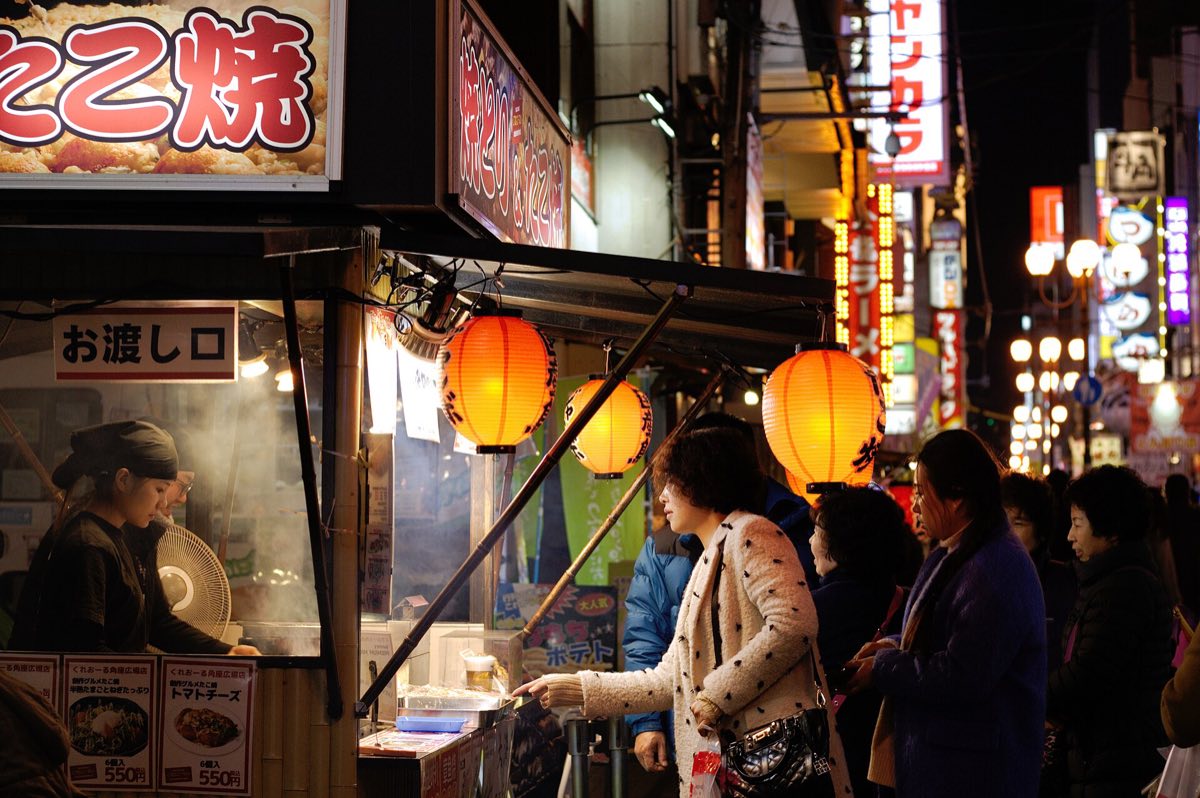
The register that matters is 粉もん — konamono, "flour things": takoyaki, okonomiyaki, kushikatsu, negiyaki. This is B-kyū gurume — cheap, unpretentious, delicious — and Osaka is its national capital. Nothing on the canon costs more than ¥1,500, which is why a food city this good can also be Japan's best-value one. The full dish list with shops and prices →
One technical fact explains half the menu: Kansai dashi is kombu-forward with light usukuchi soy — a pale, clear, delicate broth you are meant to drink to the bottom. Tokyo's is katsuobushi-forward with dark koikuchi soy, saltier, left in the bowl. This is why udon — especially kitsune udon, invented here — historically beats ramen in Osaka, and why leaving broth behind reads as a verdict. Drink it. (Osaka still has enough ramen to earn its own Tabelog top-100, so the gap has narrowed — but the broth rule hasn't.)
Michelin and Tabelog, in four figures
The 2026 numbersMichelin Kyoto-Osaka 2026 was announced in late April 2026. Read the numbers as a shape, not a scoreboard.
Tabelog beats Michelin here — and the decal beats the plate
How to pick a shopJapanese diners check Tabelog reflexively; Michelin is widely regarded as foreigner-facing and Kyoto-biased. The scale is brutally compressed — 3.5 is very good, 3.8 exceptional, 4.0+ national elite — so a shop at 3.6 that would look mediocre on Google's five-point scale is a find. The whole city holds exactly two Tabelog Gold awards: Honkogetsu in Hōzenji and the sushi counter Sanshin.
The practical version: look for the Hyakumeiten (百名店) decal in the window, not the Michelin plate. Hyakumeiten is Tabelog's annual top-100-by-category list and it's the most usable rating product in Japan — Osaka is one of the few prefectures big enough to carry its own ramen top-100, and it holds 24 of the nation's top-100 okonomiyaki shops. A Michelin plate on the door often means the prices went up; the decal means the queue is Japanese. The full 2026 Michelin breakdown →
And permission you won't get from food influencers: most great Osaka food is walk-in. The dominant local advice is Google Maps plus reviews, not a reservation platform. Learn the otoshi rule and the handful of etiquette tripwires, then just go. Reservations, otoshi and the rules →
Decide your next meal
The food clusterWhat to eat in Osaka — the dishes, priced
Takoyaki, okonomiyaki, kushikatsu and the double-dip rule, kitsune udon, battera, 551 Horai — every canonical dish with the exact shop, the price and the station exit.
Where locals eat: Tenma, Fukushima, Ura-Namba
The canonical trio Reddit repeats as a bare list. Tenma is the cheapest serious izakaya district in the city and, simultaneously, a Michelin corridor — that contrast is the story.
Is Kuromon Market worth it?
A working fish market before dawn, a tour-group queue after 11:00. Both are true. The two-hour window when it's still worth your morning, plus the named stalls that hold up.
Tsuruhashi Koreatown — the yakiniku capital
Japan's largest Korean community and the best grilled meat in the city at well below Minami prices. Two distinct zones most guides blur into one.
Michelin Osaka 2026 — stars, Bibs and one correction
The three 3-stars, the Teruya promotion, the new one-stars — and the Koryu correction most aggregators still get wrong. Plus the Bib strategy that actually fits a holiday budget.
Osaka food tours, compared honestly
Osaka is high-effort, low-legibility — the one city where a night-one food tour pays for itself in every later dinner. The table, the math, and when to skip it and DIY Tenma.
Reservations, otoshi and the rules
The seating charge nobody explains, the no-tipping rule, booking channels that work without a Japanese phone number — and permission to just walk in.
Osaka at night — where the city runs late
Dotonbori is the photo walk, not the dinner. Where the city actually drinks after 22:00, the tout rule, and the baseball nights that can shut the whole strip.
Night one, solved
Shortcut the learning curveOsaka's best food is the hardest to find in Japan — which is exactly why a first-night tour here beats one in Tokyo or Kyoto. Every later dinner cashes in on what you learned.
Osaka food questions people actually search
FAQPage schema pairedWhat food is Osaka famous for?
The konamono canon: takoyaki (¥500–800, invented here at Aizuya), okonomiyaki in the mixed-batter Kansai style, kushikatsu in Shinsekai, kitsune udon (also invented here), negiyaki, doteyaki and pressed battera sushi. The single most-repeated traveller recommendation is simpler: a ¥500-ish 551 Horai pork bun.
Is Osaka or Kyoto better for food?
Under ¥5,000 a head, Osaka — it holds 59 Michelin Bib Gourmands to Kyoto's 47, and its izakaya districts run later and cheaper. At the kaiseki summit Kyoto still leads on stars, 98 to 81. Eat your splurge in either; eat every other dinner in Osaka.
Where should I eat in Osaka instead of Dotonbori?
Tenma, Fukushima and Ura-Namba — the trio locals name. Tested numbers: a Dotonbori-zone meal averages ¥4,000+ with ~35-minute waits, while the equivalent local-district meal runs ¥2,200–3,500 with ~8-minute waits. Tenma and Fukushima are each one Loop Line stop from Osaka Station.
What is a good Tabelog score?
3.5 is very good, 3.8 is exceptional, and 4.0+ is roughly the national top 0.1% — the scale is far more compressed than Google's. Osaka has only two Tabelog Gold restaurants in the entire city, Honkogetsu and Sanshin, which tells you how hard the top of that scale is.
Do I need restaurant reservations in Osaka?
Mostly no — the city's strength is walk-in izakaya, counters and market stalls, and locals default to Google Maps plus reviews. Book ahead only for Michelin-tier counters (weeks to months, often via byFood, TableCheck or a hotel concierge) and popular okonomiyaki names like Mizuno, where the queue can hit an hour.
Why is udon a bigger deal than ramen in Osaka?
Kansai dashi is kombu-forward with light usukuchi soy — a pale, delicate broth designed to be drunk to the last drop, which suits udon perfectly. Kitsune udon was invented here at Usami-tei Matsubaya. Ramen has caught up — Osaka carries its own Tabelog ramen top-100 — but udon is the native art form.
Continue planning
Keep decidingEat it with a local
Osaka food tours & tastings — guided street-food crawls and cooking classes with vetted operators, most with free cancellation.