"Osaka has no temples"
— here are the four that answer that.
Osaka will never out-temple Kyoto, and doesn't need to: its four keepers are free or near-free and none of them are crowded. Shitennōji is Japan's oldest officially administered temple, founded 593 AD — older than anything standing in Kyoto. Sumiyoshi Taisha's architecture predates Chinese Buddhist influence entirely, and its vermilion Sorihashi bridge is the photograph. Namba Yasaka is a giant lion head five minutes from the Dotonbori chaos, and Hōzenji Yokochō is old Osaka compressed into a 30-metre lantern alley. Do all four in half a day for a few hundred yen — then go to Kyoto for the rest, 28 minutes away.
Is it for you?
Who it suitsOsaka's temples and shrines, ranked by why you'd go
The fourShitennōji — Japan's oldest official temple
Founded by Prince Shōtoku in 593 AD, before Nara existed, and still running on the original layout. The buildings are reconstructions (this is Osaka), but the plan, the five-storey pagoda silhouette and the turtle pond are 1,400 years of continuity. Outer grounds free; the inner precinct and treasure house charge a few hundred yen. The flea market on the 21st–22nd of each month is the best browsing in the city.
Sumiyoshi Taisha — the one that predates everything
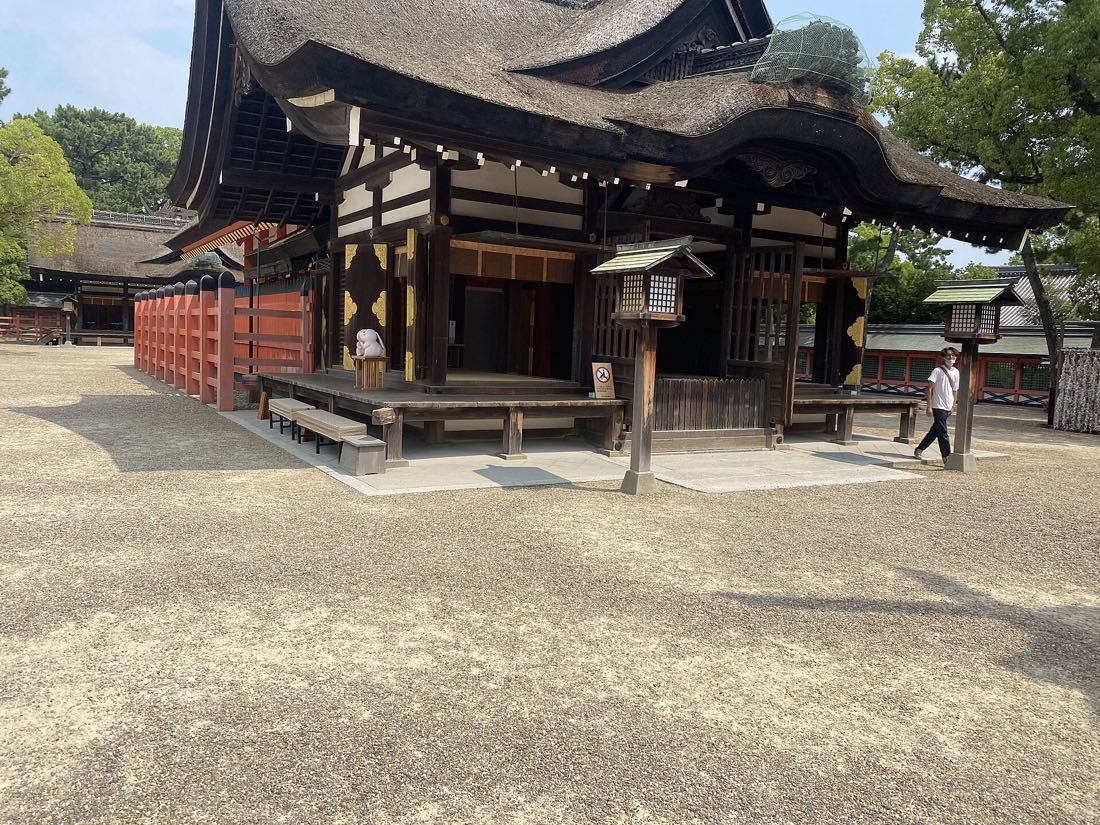
Head shrine of all 2,000+ Sumiyoshi shrines in Japan, guarding sailors since before Buddhism reached these islands — the sumiyoshi-zukuri building style, straight roofs and no curves, is one of the only surviving pre-Chinese-influence shrine forms. The steeply arched vermilion Sorihashi bridge is the money shot; cross it, since crossing is itself the purification. Free, uncrowded, and the Hankai tram from Tennoji stops at the torii.
Namba Yasaka — the lion head
A shrine stage built as a 12-metre lion head, mouth open wide enough to swallow the ceremony inside it — the mouth is said to devour bad luck and swallow victory for the devoted. One of the most photographed things in Osaka, and rightly: it takes five minutes, costs nothing, and sits a short walk from the Dotonbori crowds that never find it.
Hōzenji Yokochō — old Osaka in 30 metres
A stone-paved lantern alley one block from the Glico sign, ending at Hōzenji temple's moss-covered Fudō-myōō — moss because worshippers have splashed water on the statue for generations; splash some yourself. Thirty metres of pre-war atmosphere in the middle of the neon, and the calm-dinner alternative to the strip it hides behind.
The half-day circuit, costed
Logistics| Stop | Cost | Getting there | Time |
|---|---|---|---|
| Shitennōji 四天王寺 | Grounds free · inner precinct a few hundred yen | 10 min walk north from Tennoji Station | 45–60 min |
| Sumiyoshi Taisha 住吉大社 | Free | Nankai main line from Namba, ~10 min | 45 min |
| Namba Yasaka 難波八阪神社 | Free | 6 min walk west of Namba Station | 15 min |
| Hōzenji Yokochō 法善寺横丁 | Free | 1 block south of the Dotonbori strip | 15 min |
Natural order: Sumiyoshi (morning, Nankai from Namba) → Shitennōji → walk Tennoji → evening at Namba Yasaka and Hōzenji before dinner. Prices verified August 2026.
What Osaka's temples are — and aren't
Honest framingBe clear about the register: Osaka was firebombed in 1945 and most temple buildings here are postwar concrete reconstructions, Shitennōji's included. What's original is older than buildings — the sites, layouts and institutions. Shitennōji has operated on the same plan since 593 AD; Sumiyoshi's architectural style is a fossil from before Chinese influence reached Japan. If you want intact wooden halls and raked gravel, that inventory lives in Kyoto and Nara, both under 45 minutes away — see the Kyoto day trip and Nara day trip plans.
The advantage Osaka's set has over Kyoto's headline temples is negative space: no queue, no tour-bus wall, no ticket line. At Sumiyoshi on a weekday morning you'll share the bridge with commuters bowing on their way to work — which is its own argument. All four sites are outdoor and unshaded in stretches. Osaka summers are now genuinely dangerous: 2025 was the hottest since records began in 1898, afternoons run 36–38°C at 70% humidity, and nights stay above 25°C. From late July to mid-September, plan indoor afternoons and treat 10:00–17:00 as heat-illness territory, not sightseeing time.
The practical bit — Shitennōji
Plan your visitThe history needs a guide more than the neon does
With a narratorOsaka's temple story — merchant city, oldest temple in Japan, shrines older than Buddhism — is invisible without someone telling it.
Osaka temple questions people actually search
FAQPage schema pairedDoes Osaka have any temples worth visiting?
Four, genuinely: Shitennōji (founded 593 AD — Japan's oldest official temple), Sumiyoshi Taisha (pre-Buddhist shrine architecture and the arched Sorihashi bridge), Namba Yasaka's giant lion head, and the Hōzenji Yokochō lantern alley. All free or a few hundred yen, all uncrowded by Kyoto standards.
Is Shitennōji older than Kyoto's temples?
Yes — Shitennōji was founded in 593 AD, two centuries before Kyoto was even established as the capital (794 AD). The current buildings are postwar reconstructions, but the temple has operated continuously on the same layout for over 1,400 years.
Is Sumiyoshi Taisha worth the trip south?
If you care about shrine architecture, absolutely — sumiyoshi-zukuri is one of the only styles predating Chinese Buddhist influence, and the vermilion Sorihashi bridge is one of Osaka's best photographs. It's ~10 minutes from Namba on the Nankai line and completely free.
What is the lion head shrine in Osaka?
Namba Yasaka Shrine, a 6-minute walk west of Namba Station. Its stage is built as a 12-metre lion head whose open mouth is said to swallow bad luck. Free, small and quick — 15 minutes covers it, ideally en route to dinner.
Why is the statue at Hōzenji covered in moss?
Worshippers splash water over the Fudō-myōō statue when they pray — decades of it have grown a full coat of moss. Join in; that's the custom. The lantern-lit alley it sits in, Hōzenji Yokochō, is one block from Dotonbori and the best 15 minutes of old Osaka in the city centre.
Should I skip Kyoto if I see Osaka's temples?
No — they're different products. Osaka gives you antiquity of institutions (593 AD) without crowds; Kyoto gives you intact historic buildings and gardens at scale. Kyoto is 28 minutes and ¥580 away, so the correct answer is both, from an Osaka base.