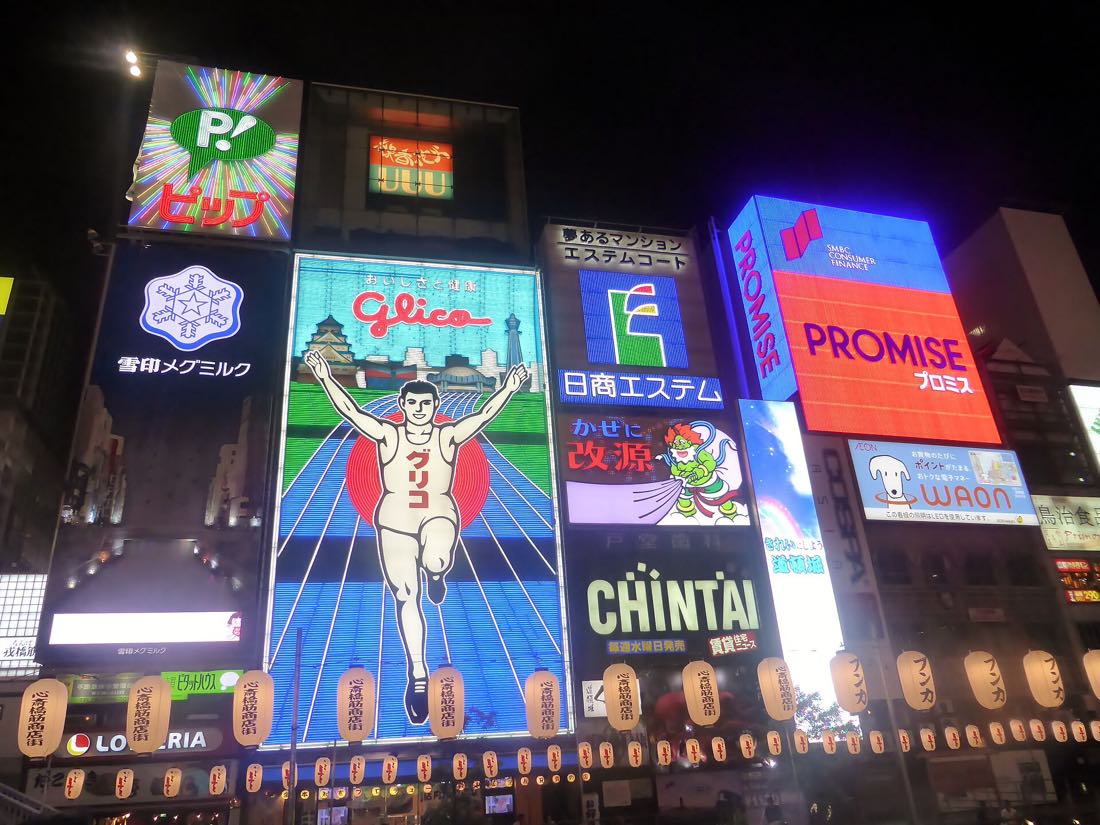
Is Dotonbori a tourist trap?
Yes — go anyway.
Dotonbori is the Times Square of Japan: a world-class visual and a mediocre place to eat. The neon canyon along the canal — the Glico runner, the giant mechanical crab, LED boats sliding underneath — costs nothing and earns its postcard at dusk. But strip-front meals average ¥4,000+ with 35-minute queues, while the same quality runs ¥2,200–3,500 with 8-minute waits one block away. So treat it as a sight: watch the neon come on, refuse every tout, then walk three minutes to Hōzenji Yokochō, Ura-Namba or Sennichimae for dinner.
Is it for you?
Who it suitsA sight pretending to be a restaurant district
The honest readThe 2026 consensus has settled: yes it's touristy, no it's not a scam, and the fix is one block.
As a New Yorker put it on Reddit, "Dotonbori is the Times Square of Japan" is a fair analogy — and nobody goes to Times Square for dinner. The 600-metre strip along the canal is overwhelmingly worth seeing: the Glico running man (photograph it from Ebisubashi bridge), the crab that moves, the neon doubling in the water. It is also measurably a bad place to eat: tested strip-zone meals averaged ¥4,000+ ($25+) with ~35-minute waits, against ¥2,200–3,500 and ~8 minutes in the neighbourhoods one block out. The heuristic that works: if the sign is in five languages, locals aren't eating there. The established names — Mizuno (Bib Gourmand okonomiyaki), Imai (udon), Kani Doraku — still deliver; the failure mode is the unnamed stall with a tout outside.
About those touts (kyakuhiki): they are the strip's one real hazard, and the rule is absolute — never follow a tout into a bar. The "all you can drink" invitations end in inflated bills you can't dispute at 01:00. Nobody who walks in off the street unrecruited has this problem.
The fix costs three minutes. Hōzenji Yokochō is a lantern-lit stone alley with a moss-covered Fudō statue — old Osaka in 30 metres, and it starts a block from the crab. Ura-Namba's pocket of small izakaya is where locals actually drink, three minutes from the Glico sign and a different planet. Sennichimae runs parallel with the food arcades. Full eating map: where to eat in Osaka.
Two 2026 planning notes. With Chinese arrivals down 56%, the strip is the quietest it's been since the pandemic — the dusk shot is genuinely easier this year. And from September to November, check the Hanshin Tigers: on potential championship-clinch nights police close Dotonbori entirely while fans celebrate by jumping in the canal — locals call it a classic Osaka cultural experience, but your dinner plan is done. Osaka summers are now genuinely dangerous: 2025 was the hottest since records began in 1898, afternoons run 36–38°C at 70% humidity, and nights stay above 25°C. From late July to mid-September, plan indoor afternoons and treat 10:00–17:00 as heat-illness territory, not sightseeing time.
When the strip actually fills
Hour clockThe strip runs on a schedule as fixed as the trains — empty mornings, neon evenings.
Neon at full burn and the strip at full density. This is the show, 19:00–22:00.
Where to actually eat, by walk time
The one-block fix| Walk to | What it is | From the Glico sign | Verdict |
|---|---|---|---|
| Hōzenji Yokochō lantern alley, moss-covered Fudō statue | Old Osaka in 30 metres — calm counters and kappo | 3 min | WORTH IT |
| Ura-Namba the 'back Namba' izakaya pocket | Small bars and counters where locals drink | 3–5 min | WORTH IT |
| Sennichimae the parallel arcade | Food arcades locals cross the canal for | 2 min | WORTH IT |
| The strip itself five-language menus, touts | ¥4,000+ meals, ~35-min queues — visibility, not quality | 0 min | SKIP |
Exceptions on the strip: Mizuno, Imai, Kukuru, Honke Otako and the other institutions still do what they do. The failure mode is the unnamed stall. Prices verified August 2026.
The practical bit
Plan your visitBook the neon, not the queue
Do it properlyThe strip itself is free. The three things worth money here all get you through it with a purpose.
Dotonbori questions people actually search
FAQPage schema pairedIs Dotonbori free?
Completely. The neon, the Glico sign, Ebisubashi bridge and the canal boardwalk cost ¥0. You only spend money if you eat, drink or take the ~20-minute river cruise — and the eating is better one block away for ¥2,200–3,500.
Is Dotonbori a tourist trap?
It's a sight, not a scam. The strip's restaurants average ¥4,000+ with 35-minute waits while equivalent meals run ¥2,200–3,500 with 8-minute waits a block off — but nothing about the street itself costs money or cheats you. Treat it like Times Square: photograph it, then leave to eat.
What time should I go to Dotonbori?
Arrive at golden hour and stay through dusk — the neon switching on over the canal is the whole event. Density peaks 19:00–22:00. Before 10:00 the strip is empty and unlit, which makes for strange, excellent photos and zero atmosphere.
Where should I eat near Dotonbori?
Walk 2–5 minutes: Hōzenji Yokochō for calm counters in a lantern alley, Ura-Namba for the izakaya pocket where locals drink, Sennichimae for the arcades. On the strip itself, stick to institutions like Mizuno (Bib Gourmand) and Imai — skip anything with a tout outside.
What exit do I take for Dotonbori?
Namba Station Exit 14 or B — about 5 minutes to the canal. Coming from the north, Shinsaibashi Station Exits 4–6 put you at the top of the covered arcade, a 5-minute walk down to the Glico sign.
Are the touts in Dotonbori dangerous?
Not physically — but never follow one into a bar. The 'all you can drink' pitches end in bills of ¥10,000+ that you can't dispute. Walking into any bar unrecruited, off your own research, carries none of this risk.
Why was Dotonbori closed at night?
Almost certainly baseball. When the Hanshin Tigers clinch a championship (possible September–November), police close the strip while thousands celebrate — and a few jump into the canal. It's a genuine Osaka tradition; plan dinner elsewhere that night.