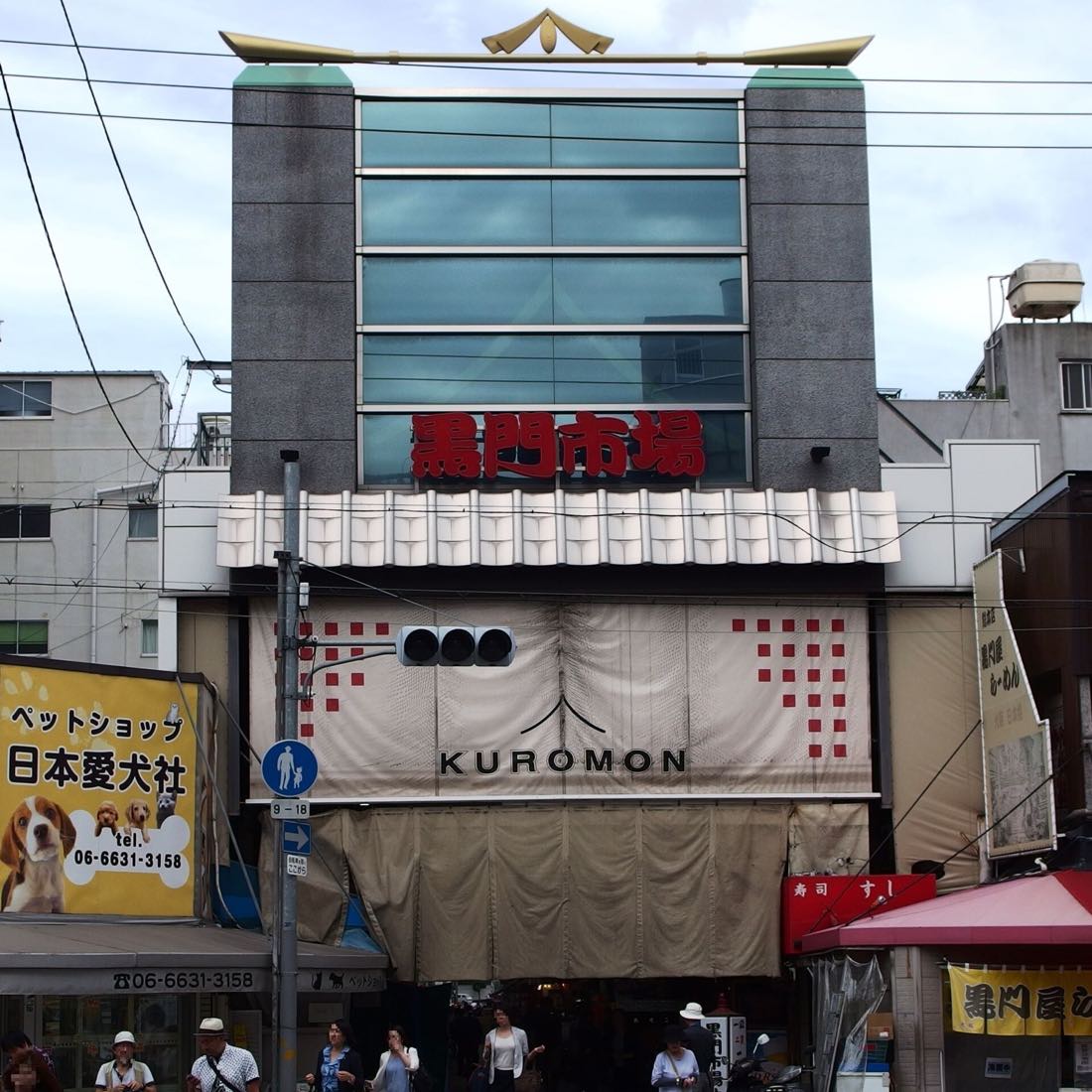
Is Kuromon Market worth it?
Before 11am, yes.
Both reputations are earned, two hours apart. Kuromon has run since around 1902 and is still a working professional market before dawn — restaurant buyers shop it at 5–7am and won't accept substandard fish, so the supply chain under your breakfast is real. But the market has restructured around standing tourist consumption, and the critics' numbers are real too: ¥1,000–2,000 for a single slice of melon, ¥800 uni gunkan, wagyu skewers at ¥800–1,500. After 11am the tour groups land and the character flips entirely. Go 09:00–11:00 on a weekday, budget ¥2,000–4,000, buy from stalls with visible turnover and Japanese customers, and skip anything priced per-slice for photography.
A real market and a tourist trap share the same 600 metres
The honest versionThe trap case and the still-worth-it case are both true. What separates them is the clock.
The trap case, first, because it's the majority 2025–26 position: the 600-metre covered arcade has reoriented from wholesale grocery toward eat-while-standing tourism. Documented 2026 prices: tuna sashimi ¥500–1,500, oysters ¥300–500 apiece, wagyu skewers ¥800–1,500, Kobe beef plates ¥3,500–4,500, uni gunkan ¥800 a piece — and the number critics cite most, a single slice of melon at ¥1,000–2,000. The grill-it-in-front-of-you scallop theatre is a post-2015 invention, not a tradition. After ~11am, tour groups arrive and the aisles become a shuffling queue.
The still-worth-it case: Kuromon is structurally two markets. Before dawn it's professional — Osaka restaurant buyers work the fish stalls at 5–7am and their standards don't flex, which means the morning stock you're eating off is genuinely good. Stalls run by merchants who predate the tourism wave — a tuna house from 1927, the uni counter, the unagi griller — hold their quality because their real customers would leave otherwise. Eat at those, in the morning, and Kuromon delivers a better breakfast than anything in Dotonbori.
Red flags, portable to any market in Japan: pre-cut seafood sitting idle on ice, multilingual photo menus, anyone soliciting you into a stall, and per-slice pricing on fruit. The counter-heuristic: follow the line, not the sign — a queue of Japanese shoppers at 10am is the single best signal in the market.
The stalls that hold up
Where to actually spend| Stall | Order | Price | Verdict |
|---|---|---|---|
| Entoki Maguro 円時まぐろ tuna merchant since 1927 — the pros' stop | Maguro sashimi, cut to order | ¥500–1,500 | WORTH IT |
| Kuromon Sanpei 黒門三平 the seafood generalist | Uni gunkan — best 09:00–10:30 while the morning stock is fresh | ~¥800 | WORTH IT |
| Sengyo Uotoyo 鮮魚魚豊 the unagi griller | Unagi over rice | ¥2,000 | WORTH IT |
| Ishibashi Foods 石橋食品 the old-school prepared-food stall | Oden, winter mornings especially | ¥1,200 | WORTH IT |
| Takahashi Foods 高橋食品 tofu maker | Fresh-ground soy milk | ¥350 | WORTH IT |
| Any per-slice fruit stand melon by the slice, strawberries on sticks | Nothing — this is photography pricing | ¥1,000–2,000 a slice | SKIP |
Prices verified August 2026 · ¥2,000–4,000 (~$13–25) per person covers a proper grazing breakfast.
The Kuromon clock
Hour clockThe market's character changes completely three times a day. The 09:00–11:00 weekday window is the entire strategy.
The sweet spot opens: full stalls, morning stock, Japanese shoppers, no coaches. Eat now.
The alternatives nobody sells you
If you miss the windowArriving at noon? Don't force it. Tenjinbashisuji — Japan's longest arcade at 2.6 km, in Tenma — is real local shopping with real prices. The depachika (department-store food basements) at Hanshin and Daimaru in Umeda and Daimaru in Shinsaibashi sell arguably better seafood than Kuromon's tourist rows at comparable or lower prices, beautifully packed. And Kizu Ichiba in Naniwa-ku is the genuinely local wholesale market — barely touristed, rough-edged, morning-only in spirit.
One more calendar note: avoid Sundays entirely — a large share of Kuromon's proper stalls take the day off, leaving mostly the tourist-facing rows. The market you came for isn't there on Sunday.
The practical bit
Plan your visitIf you'd rather eat with a local ordering
Guided or skip-the-guessworkKuromon Market questions people actually search
FAQPage schema pairedIs Kuromon Market a tourist trap?
After 11am, mostly yes — tour groups, per-slice fruit at ¥1,000–2,000 and photo-menu stalls. Before 11am on a weekday, no — it's a working market running off a professional fish supply chain, with century-old merchants like Entoki Maguro (since 1927) selling at fair prices. Same market, two hours apart.
What time should I go to Kuromon Market?
09:00–11:00 on a weekday. Earlier (5–7am) it belongs to restaurant buyers; after 11am the coaches arrive and it becomes a queue. Never on Sunday — many of the proper stalls close and mostly the tourist rows remain.
How much does Kuromon Market cost?
Entry is free; a fair grazing budget is ¥2,000–4,000 per person (~$13–25). Benchmarks: soy milk ¥350, uni gunkan ~¥800, oden ¥1,200, unagi rice ¥2,000. If a stall wants ¥1,000–2,000 for a slice of melon, that's photography pricing — walk on.
What should I eat at Kuromon Market?
Tuna from Entoki Maguro, uni gunkan at Kuromon Sanpei before 10:30, unagi rice (¥2,000) at Sengyo Uotoyo, oden at Ishibashi, fresh soy milk (¥350) at Takahashi. Skip the grill-in-front-of-you scallop theatre — it's a post-2015 act for cameras, not a tradition.
How do I get to Kuromon Market?
Nippombashi Station (Sennichimae and Sakaisuji lines, S17/K17), Exit 10, two minutes. From Namba it's a 10-minute walk east. The market is one covered 600-metre arcade — you can't get lost in it.
Is Kuromon Market open on Sunday?
The arcade is open but a large share of the real stalls — the fishmongers and old merchants — take Sunday off, leaving the tourist-facing rows. If Sunday is your only market day, go to a depachika (Hanshin or Daimaru food basements) instead; the seafood is arguably better and fairly priced.
Continue planning
Keep decidingEat it with a local
Osaka food tours & tastings — guided street-food crawls and cooking classes with vetted operators, most with free cancellation.