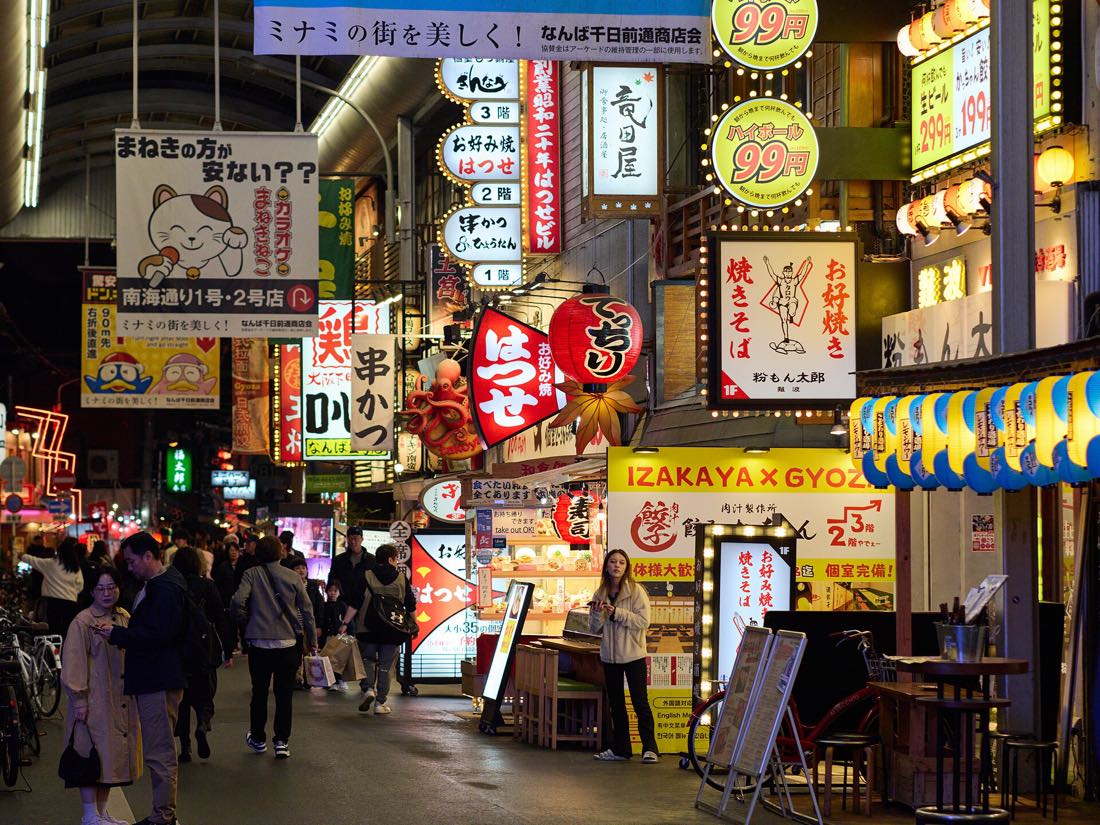
Where locals eat in Osaka —
one Loop stop from the queues.
Ask where Osakans eat and the same three districts come back as a bare list: Tenma, Fukushima and Ura-Namba. Tenma is the cheapest serious izakaya district in the city and, at the same time, a Michelin corridor — that contradiction is the most Osaka fact there is. Fukushima is the quality tier one Loop stop the other way. Ura-Namba is three minutes' walk from the Glico sign and a different planet from Dotonbori. The measured gap: local-district dinners run ¥2,200–3,500 with ~8-minute waits against Dotonbori's ¥4,000+ and ~35 minutes. Same city, better food, half the price.
Tenma, Fukushima, Ura-Namba — in that order
The canonical trioEach solves a different evening. Learn all three and you never eat badly in Osaka again.
Tenma (天満) is the story. One Loop Line stop from Osaka Station at JR Temma, it is simultaneously the cheapest serious drinking district in the city — hundreds of izakaya and standing bars spilling around Japan's longest shopping arcade, the 2.6 km Tenjinbashisuji — and a Michelin corridor: Tenma, Nishi-Tenma and Higashi-Tenma hold a cluster of one- and two-star restaurants, including 2026's new one-star Empathie in Nishi-Tenma. ¥300 skewers and tasting menus share the same blocks. No other district in Japan runs that range, and nobody writes it.
Fukushima (福島) is the quality tier — one Loop stop the other direction from Osaka Station, at JR Fukushima. Where Tenma is loud and fluorescent, Fukushima is small counters, better knives, slightly higher bills and almost no English signage. It's the district serious eaters name when Tenma feels too rowdy — and it's still a fraction of Kitashinchi money.
Ura-Namba (裏なんば) — "back Namba" — is the pocket of small izakaya, standing bars and counters behind Namba's main drags, three minutes from the Glico sign and a different planet from it. This is where Minami locals actually drink, and it's the answer when you're staying in Namba and refuse to queue on Dotonbori. Start around the Misono Building and drift.
Six districts, ranked by register
The full map| District | Register | Get there | Verdict |
|---|---|---|---|
| Tenma 天満 cheapest serious izakaya + a Michelin corridor | Rowdy, cheap, brilliant | JR Temma, 1 Loop stop from Osaka Stn · 1 min walk | WORTH IT |
| Fukushima 福島 small counters, better knives | Quality tier, low-key | JR Fukushima, 1 Loop stop from Osaka Stn · 1 min | WORTH IT |
| Ura-Namba 裏なんば where Minami locals drink | Dense, late, walk-in | 3 min from the Glico sign, around the Misono Building | WORTH IT |
| Kitashinchi 北新地 upscale dining and hostess bars — a Michelin cluster | Expense-account ⚠ watch the bill | Kitashinchi Stn / 10 min from Umeda | DEPENDS |
| Jūsō 十三 unreconstructed Shōwa nightlife, home of negiyaki | Honest, rough-edged after dark | Hankyu from Umeda, 4 min | DEPENDS |
| Tsuruhashi 鶴橋 the yakiniku capital — Koreatown | Smoke, grills, market maze | Full Tsuruhashi guide | WORTH IT |
Dinner benchmarks verified August 2026: local districts ¥2,200–3,500 (~$14–22) a head with drinks modest; Dotonbori-zone equivalents ¥4,000+ (~$25+).
Tachinomi: standing bars without the panic
The how-toTenma and Ura-Namba run on tachinomi — standing bars. The protocol: take a spot at the counter, order drink first, then food a couple of plates at a time. You pay as you go or run a small tab; cash is still the default at the older ones. The small dish that arrives unordered is otoshi, a ¥300–500 seating charge, not a mistake — full explanation here. Don't linger long after your last drink; the economics of a standing bar are turnover, and locals respect that.
Two heuristics do the work of every restaurant list. First: if the sign is in five languages, locals aren't eating there. Second, for markets and lunch spots: follow the line of Japanese customers at 10am — a queue of locals mid-morning is the single most reliable quality signal in the city. Corollary worth internalising: a popular area isn't automatically a trap — a trap is a place with no repeat customers. Dotonbori's century-old institutions still earn their queues; the unnamed stall beside them doesn't.
The practical bit
Plan your crawlLearn the districts in one night
Guided first, solo afterA guide pays off precisely here — these districts have no English menus and no obvious front door. One guided night, then every later dinner is yours.
Where-locals-eat questions people actually search
FAQPage schema pairedWhere do locals actually eat in Osaka?
Tenma, Fukushima and Ura-Namba — the three districts Osakans name when asked. Tenma and Fukushima are each one Loop Line stop from Osaka Station; Ura-Namba is three minutes from the Glico sign. Expect ¥2,200–3,500 a head with roughly 8-minute waits, versus ¥4,000+ and 35 minutes in the Dotonbori zone.
What is Tenma known for?
Being both things at once: the cheapest serious izakaya district in Osaka — hundreds of tiny bars around the 2.6 km Tenjinbashisuji arcade — and a genuine Michelin corridor, with one- and two-star restaurants clustered through Tenma, Nishi-Tenma and Higashi-Tenma. Start at JR Temma station, one stop from Osaka Station.
What is Ura-Namba?
"Back Namba" — the dense pocket of small izakaya and standing bars behind the tourist drags, centred loosely on the Misono Building, three minutes' walk from the Glico sign. It's where locals drink in Minami. No English menus, no touts, walk-in culture — pointing at what your neighbour ordered works fine.
How does a tachinomi standing bar work?
Claim counter space, order a drink first, then food a plate or two at a time; pay as you go or settle a small tab at the end, cash preferred at older places. The unordered ¥300–500 starter is otoshi, a standard seating charge. Stay for two or three drinks, not the whole night — turnover is the deal.
How do I spot a tourist-trap restaurant in Osaka?
Two signals: a menu in five languages means locals aren't eating there, and no queue of Japanese customers at a place charging premium prices means the market has already voted. The reverse also holds — a line of local shoppers at 10am is the best quality signal in the city, better than any star rating.
Is Kitashinchi worth it?
Only with a budget in mind. It's Osaka's upscale night district — Michelin counters (2026's new one-star Sushi Shigenaga among them) beside hostess clubs — and bills climb fast, with bar seating charges far above izakaya otoshi. For the same money you can eat twice as well at a Tenma two-star's lunch. Splurge deliberately or not at all.
Eat it with a local
Osaka food tours & tastings — guided street-food crawls and cooking classes with vetted operators, most with free cancellation.