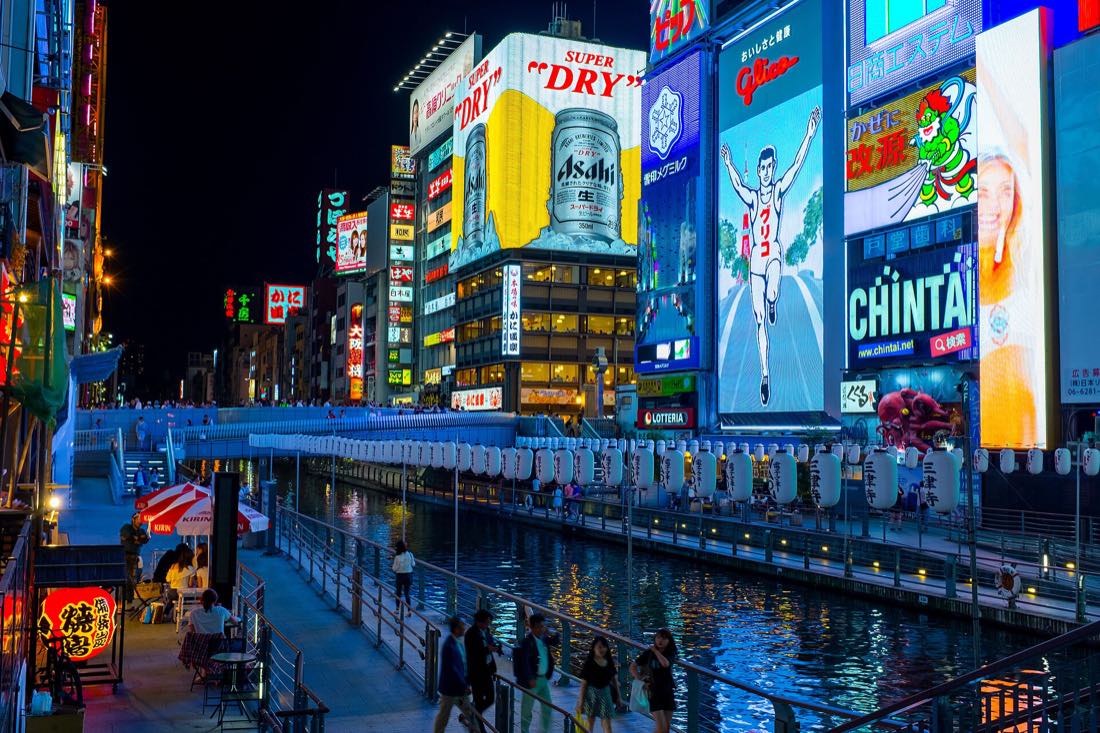
Osaka at night —
the neon is the appetiser.
Osaka runs later, louder and friendlier after dark than anywhere else in Kansai — but Dotonbori is the photo walk, not the night out. Shoot the neon at its 19:00–22:00 peak, then walk three minutes into Ura-Namba or ride one Loop stop to Tenma, where the standing bars and izakaya run on locals and honest prices. Jūsō is the unreconstructed Shōwa version, four minutes from Umeda; Kitashinchi is the expense-account version — watch the seating charges. Two rules cover the risks: never follow a tout into a bar, and if the Hanshin Tigers clinch between September and November, Dotonbori may effectively shut — locals call it a classic Osaka cultural experience, and it's best watched from the edge.
Five night districts, one honest ranking
The circuitResidents' verdict on their own city: it's lively late, people talk on the trains home, and the best rooms have six seats. Route accordingly.
Start at Dotonbori at dusk — the Glico sign, the canal reflections, the crab. It is genuinely one of the great neon views in Asia and it costs nothing. Then leave: the strip's restaurant tier charges ¥4,000+ with 35-minute queues for food the side streets do better at half that. Ura-Namba, three minutes east around the Misono Building, is the pocket of izakaya and standing bars where Minami locals actually drink. Tenma, one Loop stop from Osaka Station, is the cheap-and-brilliant version that runs loudest of all. Both, mapped →
Jūsō — four minutes on Hankyu from Umeda — is the honest register: unreconstructed Shōwa nightlife, negiyaki grills, very few foreigners, and yes, parts of it feel seedy after dark; that's the district working, not failing. Kitashinchi is the opposite pole — Osaka's upscale bar and hostess quarter, home to Michelin counters and to seating charges that can multiply a bill; go deliberately or not at all. And for the under-30 crowd, Amerikamura and Den Den Town run streetwear, clubs and arcade neon into the small hours — Osaka's youth culture happens there, not on the canal.
The Dotonbori clock
Hour clockThe strip has three completely different characters in one 24-hour cycle. Time the photo, then get out.
Peak neon. 19:00–22:00 is the postcard — dense, loud, and exactly what you came to see once.
The districts, by register and wallet
Pick your night| District | Register | Damage | Verdict |
|---|---|---|---|
| Ura-Namba 裏なんば izakaya pocket 3 min from the Glico sign | Local, dense, late | ¥2,500–4,000 | WORTH IT |
| Tenma 天満 the cheap-izakaya capital | Loud, fluorescent, brilliant | ¥2,200–3,500 | WORTH IT |
| Jūsō 十三 Shōwa nightlife, Hankyu 4 min from Umeda | Honest, rough-edged — few foreigners | ¥2,000–3,500 | DEPENDS |
| Kitashinchi 北新地 upscale bars & hostess clubs | Expense-account ⚠ seating charges stack | ¥10,000 can vanish fast | DEPENDS |
| Dotonbori 道頓堀 the neon strip itself | Photo walk, tout gauntlet | Free to walk — that's the point | WORTH IT |
| Amerikamura & Den Den youth culture, clubs, arcades | Under-30 energy | Cover charges vary | DEPENDS |
Damage = typical per-person evening with drinks, verified August 2026. Kitashinchi is deliberately unbounded — that's the warning.
Touts, and the baseball nights
The two warningsNever follow a tout into a bar. No exceptions. The kyakuhiki working Dotonbori and Higashi-Shinsaibashi — including the "all-you-can-drink" girls with laminated menus — front for rooms where the bill arrives with invented charges and the door has someone large beside it. Every bar worth drinking in is one you walked into yourself. This is the single rule that prevents essentially all Osaka nightlife trouble; the city is otherwise extremely safe at night.
And the calendar quirk no guide mentions: Hanshin Tigers clinch nights. When the Tigers close on a championship — September to November window — Dotonbori can effectively shut down: police line the bridges, fans mass along the canal (the famous celebration is jumping in), and hotel staff hand guests translated warnings. Locals describe it, fondly, as a genuine classic Osaka cultural experience. If you hit one, watch from the edge of the crowd, keep your phone zipped, and drink in Ura-Namba — the strip will be a police operation until late.
Three ways to spend the first night
Guided after darkOsaka-at-night questions people actually search
FAQPage schema pairedIs Osaka good for nightlife?
The best in Japan outside Tokyo — and friendlier. Minami runs latest and densest: Ura-Namba's izakaya pocket sits three minutes from the Glico sign, Tenma pours the cheapest serious drinks in the city (¥2,200–3,500 evenings), and Jūsō keeps unreconstructed Shōwa nightlife four minutes from Umeda. The strip itself is the photo, not the party.
Is Dotonbori worth visiting at night?
Yes — once, at the right hour. The neon peaks 19:00–22:00 and costs nothing to walk; 05:00 gives you the signs with nobody in frame. Eat and drink elsewhere: the strip averages ¥4,000+ meals with 35-minute waits, while Ura-Namba, three minutes away, halves both numbers.
Is Osaka safe at night?
Very — by international standards, remarkably so. The one live risk is self-inflicted: following a tout (or an "all-you-can-drink" promoter) into a bar, which is how inflated-bill stories happen. Walk into places yourself and the city gives you no trouble. Jūsō and parts of Shinsekai feel seedy without being dangerous.
What is the tout scam in Dotonbori?
Street promoters — kyakuhiki — steer tourists into bars where cover charges, drink minimums and "service fees" appear on the bill after the fact. The fix is absolute: never follow a tout in, however friendly the pitch. Legitimate bars in Osaka don't need to pull customers off bridges.
Why was Dotonbori closed for a baseball game?
Hanshin Tigers clinch nights. When the Tigers seal a championship (September–November), fans flood the canal area, police close the bridges, and celebrating supporters famously jump into the river. Locals treat it as classic Osaka culture rather than a riot — but the strip effectively shuts, so drink in Ura-Namba and watch from the edge.
What time do trains stop running in Osaka?
Around midnight, give or take by line — and the districts empty noticeably as last trains approach. If you're staying out past that, plan on a taxi home or drink near your hotel; Namba-based visitors have the shortest stumble, which is one more argument for basing in Minami.